
Comparison of Food Packaging Printing Processes: Digital Printing vs. Gravure Printing — Choosing the Best Solution for Your Brand
In the packaging industry, the choice of printing process directly impacts product market performance, cost control, and brand image. As a packaging solutions provider with nearly 10 years of industry experience, we deeply understand the importance of different printing processes to the success of food brands. This article will provide an in-depth comparison of the two mainstream processes—digital printing and gravure printing—to help you make the most informed decision for your brand.
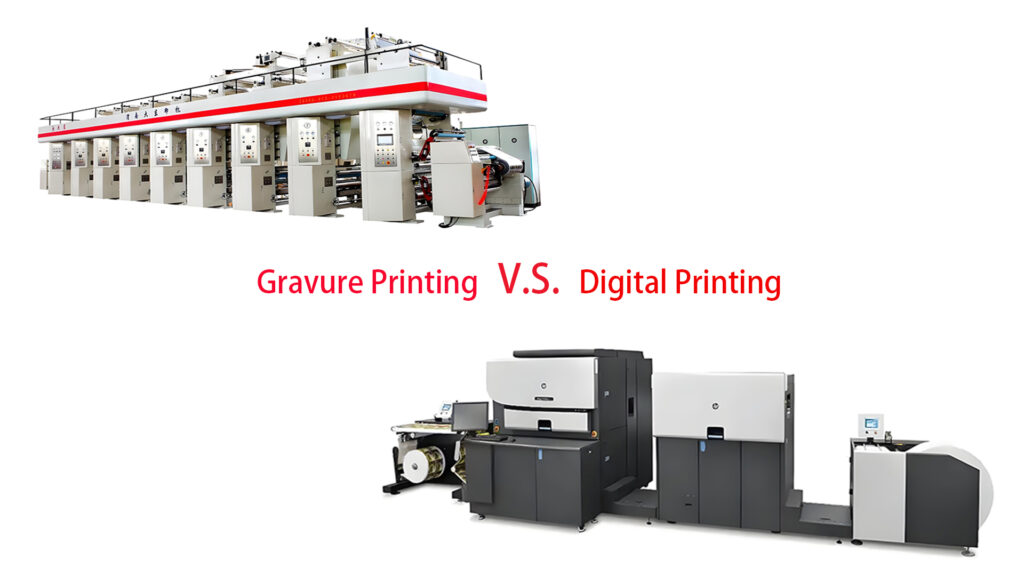
Overview of Printing Processes: Technical Principles Determine Application Scenarios
• Digital Printing: The Synonym for Flexibility
Digital printing uses electronic images(Such as AI/PDF/PSD) to directly drive printing equipment to print onto packaging materials without the need for a plate-making process. Its core features are “print-on-demand” and “plate-less printing,” making it particularly suitable for modern brands’ requirements for personalization and rapid response to market demands.
• Gravure Printing: The Perfect Combination of Quality and Efficiency
Gravure printing involves engraving a gravure cylinder and transferring images by filling the engraved depressions with ink. This traditional process demonstrates unparalleled advantages in large-scale production, particularly in terms of color saturation and printing precision.
Core Comparison Analysis: Addressing Key Customer Pain Points
1. Cost-Benefit Analysis: Key Considerations for ROI
Digital Printing Cost Structure:
• Minimum Order Quantity Advantage: No minimum order quantity restrictions, starting from 1 piece
• No Plate Making Costs: Eliminates traditional plate making costs (typically $500–2,000 per set), allowing for design modifications at any time
• Suitable Scenarios: The optimal choice for orders of 1,000–5,000 units, significantly reducing printing preparation time and enabling faster response to new product launches.
Case Study: A German organic food brand required 2,000 units each of six different flavored packaging bags during the product testing phase. Choosing digital printing helped them save $4,200 in plate-making costs and complete delivery within two weeks, successfully meeting the product launch deadline for the European Organic Food Exhibition.
Gravure Printing Cost Structure:
• Economies of Scale: Unit costs are significantly reduced for orders over 10,000 units
• Plate Investment Payback: Plate costs are spread to extremely low levels during large-scale production
• Long-Term Collaboration Advantages: Repeat orders incur nearly zero startup costs
• High Scratch Resistance: Ink adheres firmly, withstanding friction during transportation and stacking processes
Case Study: A North American pet food manufacturer with annual revenue of $20 million produced 500,000 high-barrier stand-up pouches using gravure printing, requiring exquisite printing and consistent color. Gravure perfectly reproduced the complex design, with a unit price 35% lower than digital printing, resulting in annual packaging cost savings exceeding $150,000.
2. Print Quality Comparison: A Direct Reflection of Brand Image
Digital Printing Quality Features:
• Color Accuracy: Over 95% color reproduction accuracy
• Image Detail: 300 DPI high-resolution output
• Gradient Effects: Perfectly reproduces complex gradients and photo-quality images
• Consistency Guarantee: Consistent quality across every printed piece
Advantages of Gravure Printing Quality:
• Color Saturation: Ink layer thickness reaches 3-5 times that of digital printing
• Screen Reproduction: Up to 400 lines per inch of fine screen reproduction
• Special Effects: Supports special materials such as metallic ink and fluorescent ink
• Durability: Strong ink adhesion and excellent abrasion resistance
3. Production Cycle Comparison: Competitive Advantage in Market Response Speed
Digital Printing Time Advantage:
• Sample Production: Completed within 2-3 days
• Small-Batch Production: Delivered within 5-7 business days
• Design Modifications: Immediate adjustments with no additional waiting time
Example: An Italian specialty coffee brand needed to urgently produce packaging for a limited-edition Christmas product. From design confirmation to receiving 5,000 packaging bags, the entire process was completed in just 7 days, successfully capturing the peak holiday sales period.
Gravure Printing Time Planning:
• Plate Making Cycle: 5–7 business days
• First Production Run: 18–20 business days (including plate making time)
• Repeat orders: 12-15 working days (no need for re-plate making)
4. Technical applicability analysis: Optimal matching for different needs
Digital printing applications:
• New product testing and market validation stages
• Seasonal or limited edition products
• Small batch production models with multiple SKUs
• Personalized customization needs
• Projects with high environmental protection requirements
Gravure printing applications:
• Large-scale production of mature products
• High-end brands with extremely high printing quality requirements
• Packaging requiring special printing effects
• Long-term stable product lines
• Cost-sensitive commodities
Practical Application Recommendations: Customized Solutions Based on Customer Needs
For Small and Medium-sized Brands (Annual Revenue of $5 Million to $50 Million)
Recommended Strategy: Hybrid Printing Solution
• New product testing phase: Use digital printing to verify market response
• After product maturity: Switch to gravure printing to reduce unit costs
• Seasonal products: Use digital printing to meet flexible demand
For High-End Large Food Brands
Recommended Strategy: Flexographic Printing as the Main Approach
• Utilize high-quality printing effects to enhance brand value
• Achieve cost advantages through large-scale production
• Ensure product freshness with high barrier performance
For Environmentally Conscious Brands
Recommended Strategy: Flexographic Printing Combined with Sustainable Materials
• Select biodegradable substrates (currently not supported for liquid or semi-solid products)
• Use water-based eco-friendly inks
• Implement on-demand production models
Professional Advice: Choose the Most Suitable Printing Solution
As your packaging solution partner, we recommend:
Evaluation Framework:
• Order Volume Assessment: Choose digital printing for orders of less than 5,000 pieces, and consider gravure printing for orders of 10,000 pieces or more.
• Product Life Cycle: Choose digital printing during the testing phase and switch to gravure printing during the mature phase.
• Brand Positioning: High-end brands may consider the quality advantages of gravure printing.
• Market Strategy: Flexible marketing needs may favor digital printing.
• Cost Budget: Consider plate-making costs and unit price differences comprehensively.
Our Service Advantages:
• Dual Process Capability: Equipped with both digital and gravure printing machinery.
• Professional Consultation: Providing optimal solution recommendations based on 10 years of experience
• Quality Assurance: FDA and EU certified, with a strict quality control system
• Flexible Service: No minimum order quantity restrictions, accommodating diverse scale requirements
• Global Distribution: Covering major markets such as North America, Europe, and the Asia-Pacific region
Conclusion: Technology Choice Determines Brand Future
• The choice of printing process not only affects current cost control but also impacts the long-term development of a brand.
• Whether you opt for the flexibility of digital printing or the cost-effectiveness of gravure printing, the key lies in finding the solution that best aligns with your brand’s development stage and market strategy.
• For clients testing new products, requiring quick turnaround for small orders, or with strong personalized needs, digital printing is the preferred tool; for mainstay best-selling SKUs, demanding visual performance, and large orders with strict cost control, gravure printing offers a clear advantage.
• Sorbar leverages its “dual-process integration” capability to enable seamless switching between “small-batch customization” and “large-scale stable production” for global clients. Regardless of your brand’s development stage, we can tailor the most suitable packaging printing solutions to help your products and brand stand out.
• For specific requirements or further details on production processes, please feel free to consult Sorbar’s professional team(www.sorbar.com). We are not only your packaging supplier but also a strategic partner on your brand’s growth journey.
• Case studies demonstrate our capabilities, and innovation drives the future. Choose Sorbar to make packaging the true engine of brand growth!
If you would like more professional advice on printing process selection or a customized solution for your specific project, please feel free to contact our technical team.
We will provide you with the most professional packaging solutions based on your specific needs.
Written by

You may also be interested in:
Food Packaging Seal Technology Deep Dive - Ensuring Product Safety
In the food packaging industry, sealing technology serves as the core element determining product quality, safety, and shelf life. As a packaging solutions provider with nearly a decade of professional
Advantages of stand up pouch in flexible packaging: a revolutionary solution to enhance shelf appeal
In today’s competitive retail market, packaging is more than just a tool to protect products It is the first point of contact between brands and your consumers. Stand-up pouches are
Guidelines for Selection of High Barrier Packaging Materials - Protecting Food Freshness
In the fast-moving food packaging industry, maintaining product freshness and prolonging shelf life is one of the core concerns of brand owners, and more importantly, it is the embodiment of

In-Depth Guide to Food-Grade Packaging Safety Standards: Understanding FDA and EU Approval Requirements
In the highly competitive world of food and beverage packaging, ensuring safety and compliance is critical. Brands targeting the European and North American markets must comply with stringent standards set